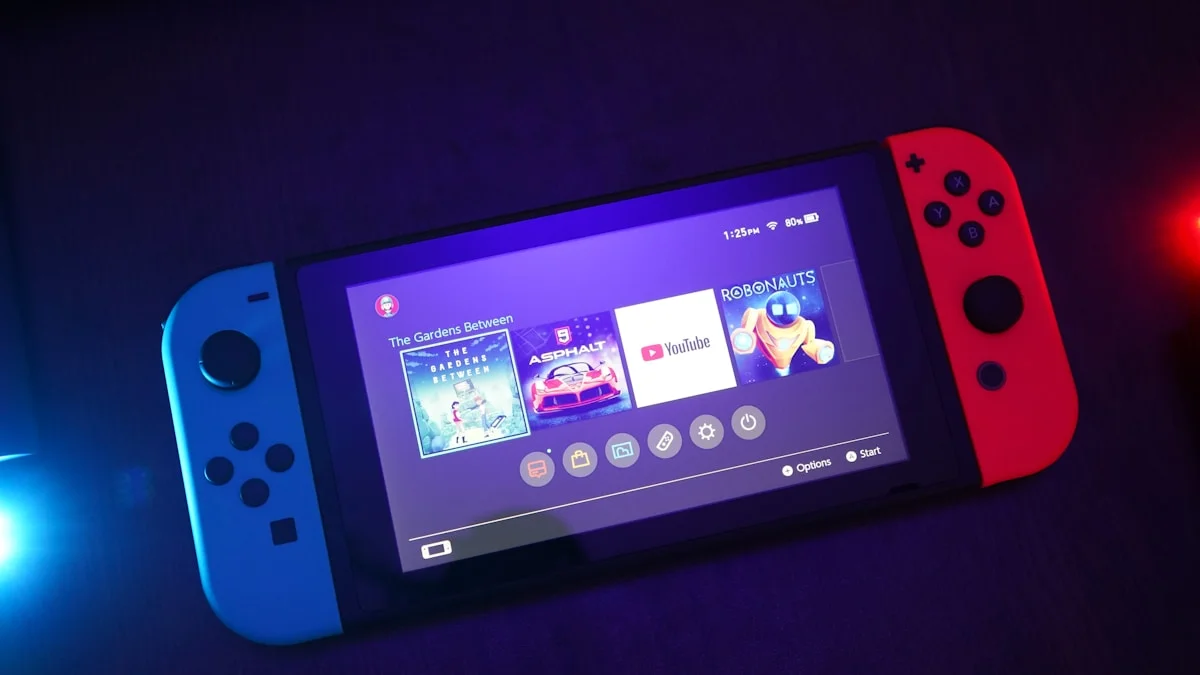
The Verdict
The Switch OLED is still a good buy in 2026, but only as the budget option next to the Switch 2. The screen and game library remain excellent; the processor is now two generations behind and Joy-Con drift is still a real risk.
Check Price on AmazonThe Good
- Sharp 7-inch OLED screen, a genuine upgrade over the original LCD Switch
- Plays Nintendo's back catalog: Zelda, Mario Kart, Animal Crossing, Pokemon
- Improved, wider kickstand that actually stays up
- Usually the cheapest way into Nintendo's library, often discounted well below the Switch 2's price
The Bad
- Same Tegra chip as the 2017 original: no faster loading, no better frame rates
- Joy-Con drift is a known, unresolved hardware issue across all Switch models
- No 4K, no docked resolution bump over the base Switch
- Nintendo's newest games and features are increasingly built around the Switch 2
Scores by category
The 7-inch 720p OLED panel is a genuine upgrade over the original LCD Switch, though docked output is still capped at 1080p like the base model.
Same 2017 Tegra X1 chip as the original Switch means no faster loading or better frame rates, and it now trails two console generations.
Access to Nintendo's back catalog, including Zelda, Mario Kart, Animal Crossing, and Pokemon, remains the strongest reason to own one.
The wider kickstand is a real improvement, but Joy-Con drift remains an unresolved hardware issue across the redesigned controllers.
MSRP rose to $399.99 in August 2025, but frequent $299.99 sales at Amazon and Walmart keep it the cheapest way into Nintendo's ecosystem.
Specifications
| Screen | 7-inch OLED, 1280x720 (720p handheld) |
|---|---|
| Docked Output | Up to 1080p via HDMI |
| Internal Storage | 64GB (expandable via microSD) |
| Battery | 4310mAh, 4.5 to 9 hours per charge |
| Weight | 0.42kg / 14.81oz (console only) |
| Wi-Fi | 802.11 a/b/g/n/ac (dual-band) |
| Bluetooth | Bluetooth 4.1 |
| MSRP | $399.99 |
grimtech is a research-and-recommendation site. Our picks come from specs, published testing, and owner feedback, not from who pays us. Links may earn a commission at no extra cost to you. See how we test.
The Bottom Line
The Nintendo Switch OLED is still a good console in 2026, but its role has changed. It used to be Nintendo’s best hardware; now it is Nintendo’s budget hardware, sitting below the Switch 2 at a lower price with the same aging internals it launched with in 2021.
Buy it if: you want Nintendo’s game library (Zelda, Mario Kart, Animal Crossing, Pokemon) at the lowest reasonable price, you play mostly in handheld mode, or you’re buying for a kid or casual gamer who doesn’t need cutting-edge hardware.
Skip it if: you want Nintendo’s newest and future games, you’ve already been burned by Joy-Con drift, or your budget stretches to the Nintendo Switch 2 at $449.99 (rising to $499.99 on September 1, 2026).
Nintendo Switch OLED on Amazon
grimtech may earn a commission from Amazon links at no extra cost to you. It does not change our verdict.
What Changed Since Launch
When the Switch OLED came out in 2021, the comparison was against the base Switch and the Switch Lite. That comparison is no longer the relevant one. Nintendo released the Switch 2 in June 2025 at $449.99 (rising to $499.99 on September 1, 2026), with a larger 7.9-inch 1080p screen, Wi-Fi 6, and magnetic Joy-Con 2 controllers.
Nintendo has repositioned the OLED model as the budget entry point, though its price has moved since launch: the MSRP rose from $349.99 to $399.99 in August 2025, part of a broader Switch-family price increase tied to tariffs and rising component costs. In practice, Amazon and Walmart have both been selling it for $299.99, so the real-world price gap to the Switch 2 is often larger than the MSRP suggests. Check the current listed price before buying, since retailers move it around. That is the honest frame for this review: not “is this the best Nintendo console,” but “is this the right Nintendo console for you, given a newer one exists and this one’s own price keeps shifting.”
There is also a longer-term wrinkle worth knowing about: Nintendo has confirmed the original Switch family, OLED included, will stop being sold in Europe from mid-February 2027, driven largely by an EU rule requiring replaceable batteries that this decade-old hardware doesn’t meet. Nintendo says it intends to keep selling the console in other markets, including the US, past that date, but it’s a signal that this hardware generation is winding down. That doesn’t make today’s console worse, but it’s a reason to buy this specifically for the games and screen you want now, not as a long-term platform bet.
The OLED Screen Is Still the Best Reason to Buy This One
The 7-inch OLED panel is the single meaningful upgrade over the original Switch’s 6.2-inch LCD, and it is a real one in handheld mode: deeper blacks, richer colors, and better contrast in games like Zelda: Tears of the Kingdom or Mario Odyssey.
That upgrade disappears the moment you dock the console. Docked output is unchanged from the base Switch, so if you play almost exclusively on a TV, the OLED screen buys you nothing and the cheaper base Switch (where still available) or Switch 2 make more sense depending on budget.
What Hasn’t Changed: The Processor
The Switch OLED runs the same Tegra X1 chip from 2017, just with a slightly more efficient manufacturing process that helps battery life, not performance. Load times, frame rates, and docked resolution are identical to the original Switch. Newer, more demanding titles run at the same modest settings they always have.
This is the trade-off buyers should go in understanding: the OLED model is a display and build-quality refresh, not a power upgrade. The Switch 2 is where Nintendo put the actual performance jump.
Joy-Con Drift: Still a Real Risk
Joy-Con drift, where the analog sticks register phantom movement over time, has followed the Switch family since 2017 and the OLED model’s redesigned Joy-Cons have not resolved it. It is not guaranteed to happen to every unit, but it is common enough that buyers should factor in the possibility of a repair or replacement pair down the line, especially for heavy handheld use.
Switch OLED vs. Switch 2 vs. Steam Deck
- Switch 2 ($449.99, rising to $499.99 on September 1, 2026): the console to buy if you want Nintendo’s newest exclusives, a bigger sharper screen, and more power, and your budget allows the difference.
- Steam Deck OLED ($789 for the 512GB model, $949 for 1TB, after Valve’s May 2026 price increase): a different category of device entirely, aimed at people who already own a Steam library and want it portable. Our Steam Deck OLED review covers it in depth, and our Nintendo Switch OLED vs Steam Deck comparison has the full breakdown.
- Switch OLED ($399.99 MSRP, commonly discounted to $299.99): the pick for anyone who wants Nintendo’s existing library at the lowest sensible price. Confirm the current price before buying, since it moves.
If portable PC gaming or a wider game library beyond Nintendo’s own is the priority, our best laptop guide and best portable SSDs roundup cover the accessory side of that setup.
Who Should Buy the Switch OLED
- Families and casual gamers who mainly want Mario Kart, Animal Crossing, and party games
- Handheld-first players who will benefit most from the OLED screen
- Anyone buying a first Nintendo console on a budget, including as a gift
- Existing Switch owners upgrading from the base model or Lite specifically for the screen
Who Should Skip It
- Buyers who want Nintendo’s newest games and features going forward: get the Switch 2 instead
- Docked-only players, who get no benefit from the OLED panel
- Anyone who has already replaced drifting Joy-Cons once and wants a design that has actually fixed the problem
- Existing Switch 2 owners; there is no reason to also own this model
Verdict: Buy It, With a Caveat
Buy the Switch OLED if the screen and Nintendo’s back catalog matter more to you than raw power or the newest hardware, and its current price, whether that’s the $299.99 sale price or the $399.99 MSRP, fits comfortably below the Switch 2. It remains a well-built, genuinely pleasant console for the money. Just go in knowing it is now the budget option, not the flagship, that Joy-Con drift is a real long-term risk rather than a solved problem, and that Nintendo has already signaled this hardware generation’s sales window is closing in some markets.
Rating: 4.4/5
Similar Products Worth Considering
Other products our team has reviewed in this category.


Tech reviews & buying advice
grimtech is an independent tech-review publication. We test and research gear, cut the hype, and give one clear recommendation you can act on. Our rule is simple: trust is the whole business, so we never let a commission shape a verdict, if the cheaper or older product is the right call, that's what we tell you. We earn affiliate commissions when you buy through our links, at no extra cost to you, and that never changes what we recommend.